

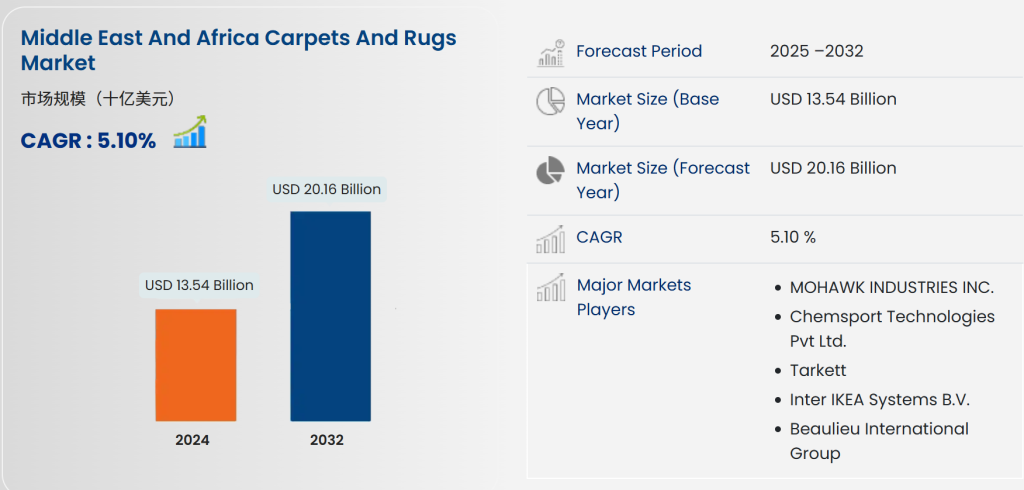
East Africa, particularly Kenya and Tanzania, has a long textile tradition. In recent years, rising living standards and global economic growth have made carpets an essential household item in the region, with demand steadily increasing. The Middle East and Africa carpet market was valued at $13.54 billion in 2024 and is projected to reach $20.16 billion by 2032, representing a compound annual growth rate of 5.1% over the forecast period.
As consumers demand higher quality home furnishings, Kenyan carpet manufacturers are stepping up R&D spending to drive product innovation and upgrades. Against a backdrop of rising global environmental awareness, green and eco-friendly practices have also become a guiding principle for Kenya’s carpet industry, aimed at sustainable development. Looking ahead, with the spread of internet technology, e‑commerce is expected to become a major sales channel for Kenya’s carpet market.

The Kenyan carpet market in 2026 offers Chinese companies a strategic window of opportunity, blessed by both timing and geography. First, manufacturing policies across East Africa remain highly favourable. Kenya’s export processing zones allow 100% foreign ownership, while Tanzania offers tariff concessions on textile machinery imports. Second, China‑Africa cooperation continues to deepen. With the advancing mechanism of the Forum on China‑Africa Cooperation (FOCAC), Chinese enterprises enjoy policy advantages far beyond those of their European and American rivals, providing a solid bridge for expansion.

At present, competition in Kenya’s carpet market is not particularly fierce. On the one hand, although there are many local manufacturers, they are generally small in scale and lack core competitiveness. On the other hand, high‑end European and American brands have entered the market with strong brand recognition and distribution networks, but their prices remain too high for most local consumers, so they have yet to capture significant market share.
In summary, for Chinese companies looking to enter the East African carpet market, the path to success lies in continuously improving product quality, leveraging trade fairs, developing digital sales models, and pursuing a differentiated strategy.